


The Art of Cartier
2012-09-18
Czas czytania 7 minut
24 October 2012 to 17 February 2013 An exhibition of the Cartier Collection at the Museo Thyssen‐Bornemisza
From 24 October this year to 17 February 2013 the Museo Thyssen‐Bornemisza will be showing The Art of Cartier, an exhibition featuring more than 420 works from the Cartier Collection, from its origins to the present day.
One of the most important on the subject organised to date due to the number of pieces on display, the exhibition reflects the spirit and artistic evolution of Cartier from the time it was founded in Paris in 1847. The Cartier brothers’ energy and their interest in the art of distant and ancient cultures laid the foundations for the artistic identity of the maison. From the Garland style to 1930s Art Deco, and from the inspiration of China to the “tutti frutti” style, the exhibition spans more than 165 years of creativity, presented in a wide‐ranging survey that encompasses numerous different types of jewellery, techniques and design styles. This exhibition has benefited from the collaboration and sponsorship of Telefónica.
The Cartier Collection
Acquired from private collections, jewellers and auctions, the more than 1,450 pieces of jewellery that make up the Cartier Collection have been individually selected on the basis of their style and inspiration, origins, materials and technical virtuosity. The result is a collection of such quality and variety that it represents a complete overview of the evolution of the designs and techniques that Cartier has used over the course of its history, while also constituting an outstandingly important item of cultural and artistic heritage.
The remarkable historical archive that Maison Cartier has preserved over the decades is a fundamental part of its collection and is consequently given considerable prominence in the present exhibition. Comprising preliminary designs, drawings, watercolours and sketches of outstanding aesthetic merit, the archive is a treasure trove largely unknown to the general public but one that offers exceptional information for an understanding of the collection in its fullest sense and for an explanation of how many of these works were created, who they were made for and why.
The designer Jorge Varela, co‐curator of the exhibition with the Museum’s Artistic Director Guillermo Solana and Paula Luengo of the Thyssen’s Curatorial Department, has designed a spectacular installation. Alongside the pieces on display there will be wall projections of the corresponding designs, as well as drawings photographs of the individuals who wore them, offering additional information of enormous historical importance and interest.
Unique pieces and exceptional loans
Some items recently acquired for the Collection will be on display here for the first time. They include the ruby and diamond necklace that was given to Elizabeth Taylor by her third husband the producer Mike Todd, and the brooch in the form of a flamingo belonging to the Duchess of Windsor, made in collaboration with Jeanne Toussaint, Cartier’s artistic director at the time. The brooch is a colouristic piece, illuminated by the bird’s multi‐coloured plumage of sapphires, rubies and calibrated emeralds. This bold interpretation of a pink flamingo represents a tradition that is both naturalistic and poetic.
The exhibition also includes various exceptional loans such as the Garland‐style tiara that belongs to the Spanish royal family, given by Alfonso XIII to Queen Victoria Eugenia in 1920. It is still worn by Queen Sofía at official ceremonies today. In addition, the Monagesque Palace has loaned various pieces including the jewels that Princess Grace wore for her official wedding photographs in 1956, given to her by Prince Rainier III.
www.museothyssen.org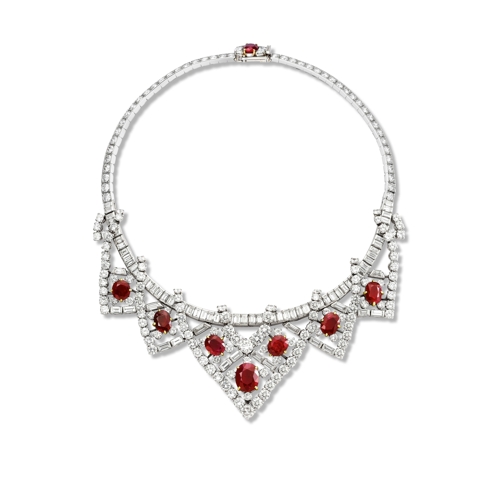
Cartier Paris, 1951, altered in 1953 Studio Gérard, Cartier Collection © Cartier
Platinum, gold Round‐, baguette‐ and fancy‐cut diamonds Eight cushion‐shaped and oval faceted rubies A tiara fitting allows the necklace to be worn as a head ornament.
Provenance: Elizabeth Taylor Length: 37.5 cm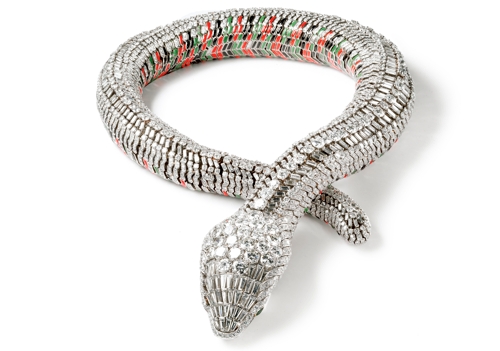
Cartier Paris, special order, 1968 Nick Welsh, Cartier Collection © Cartier
Platinum, white gold and yellow gold 2 473 brilliant‐ and baguette‐cut diamonds, weighing 178.21 carats in total Two pear‐shaped emeralds (eyes) Green, red and black enamel
Made as a special order for María Félix. Mexican diva and archetypal Latin femme fatale, Félix (1914‐2002) carried on her acting career until the late 1960s. The actress, well known in Mexico and France for films such as Emilio Fernandez’s Enamorada (1946), Jean Renoir’s French Cancan (1955), and Luis Buñuel’s Fever Rises in El Pao (1959), was a true reptile lover.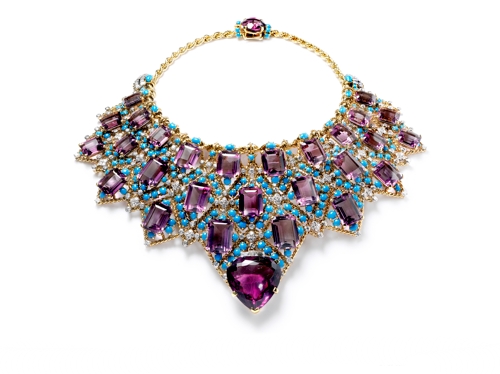
Cartier Paris, special order, 1947 Nick Welsh, Cartier Collection © Cartier
Twisted 18‐carat and 20‐carat gold, platinum Brilliant‐ and baguette‐cut diamonds One heart‐shaped faceted amethyst, twenty‐ seven emerald‐cut amethysts, one oval faceted amethyst
Turquoise cabochons
This necklace was sold to the Duke of Windsor, who supplied all the stones except the turquoises.
20.0 x 19.5 cm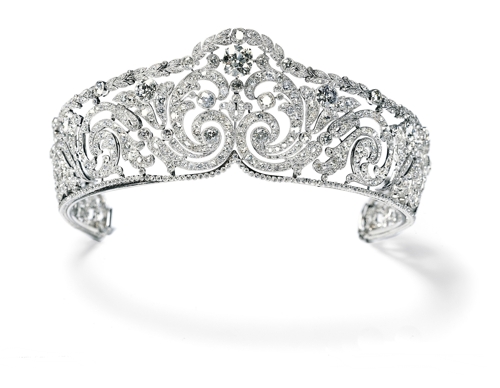
Cartier Paris, 1910 Nick Welsh, Cartier Collection © Cartier
Platinum One cushion‐shaped diamond, round old‐cut diamonds Millegrain setting
Sold to Elisabeth (1876‐1965), Queen of the Belgians. Because of her sincere personality, Eisabeth was one of the queens most loved by the Belgians people. She was the niece of the Empress of Austria better known as Sissi, and in 1900 she married Prince Albert of the Kingdom of Belgium.
Height at centre 5.5 cm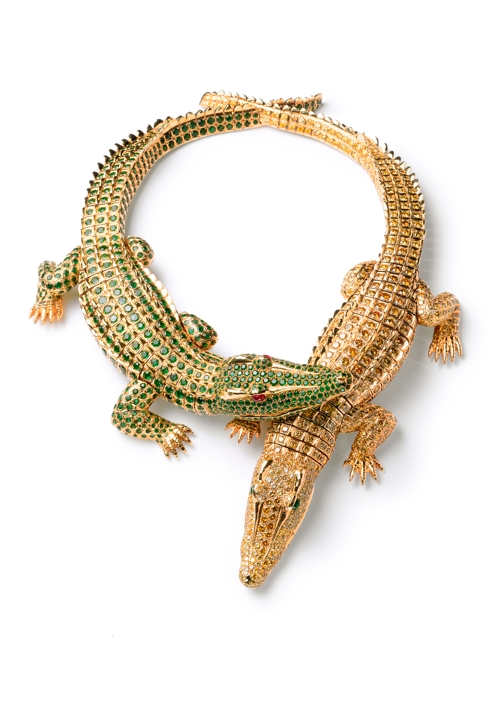
Cartier Paris, special order, 1975 Nick Welsh, Cartier Collection © Cartier
Gold 1 023 brilliant‐cut fancy intense yellow diamonds, weighing 60.02 carats in total Two navette‐shaped emerald cabochons (eyes) 1 060 emeralds, weighing 66.86 carats in total Two ruby cabochons (eyes) Entirely articulated, the two crocodiles can be worn separately as brooches or together as a necklace. When worn around the neck, the feet can be replaced by clawless paws that will not irritate the skin.
Made as a special order for María Félix. Length: 30.0 cm; length: 27.30 cm
press release